Law Firm Intake Conversion Rate Benchmarks by Practice Area
Find which stage of your intake funnel is actually losing leads—and fix it.

Conversion rate benchmarks for law firm intake get quoted constantly, and most of them contradict each other because they're measuring different things. A firm that hears "14% conversion" and a firm that hears "40%" might be looking at the exact same funnel, just cut at different points. Getting this right matters because misdiagnosing where leads die costs firms money twice: once on wasted ad spend, and again on cases that were winnable and got dropped anyway.
Three separate metrics get called "conversion rate" in legal marketing, and they don't measure the same handoff. The first is website visitor to lead: someone fills out a form, calls the office, or starts a chat. The second is lead to signed retainer, the full pipeline from first contact to signature, which is the number most firms actually care about but rarely calculate correctly. The third is consultation to signed, a narrower slice that only counts people who already showed up for a meeting.
The full picture runs in five stages: total calls received, qualified leads, consultations scheduled, consultations completed, and clients hired. Skip any of those steps and the diagnosis goes sideways. A firm staring at a disappointing overall number might blame its marketing spend when the actual leak is a consultation no-show problem, or fire the intake team when the real issue is a closer who can't get paid consultations across the line. Stage-by-stage measurement is the only way to tell those apart.
Industry-wide baselines: what the average firm achieves across the whole funnel
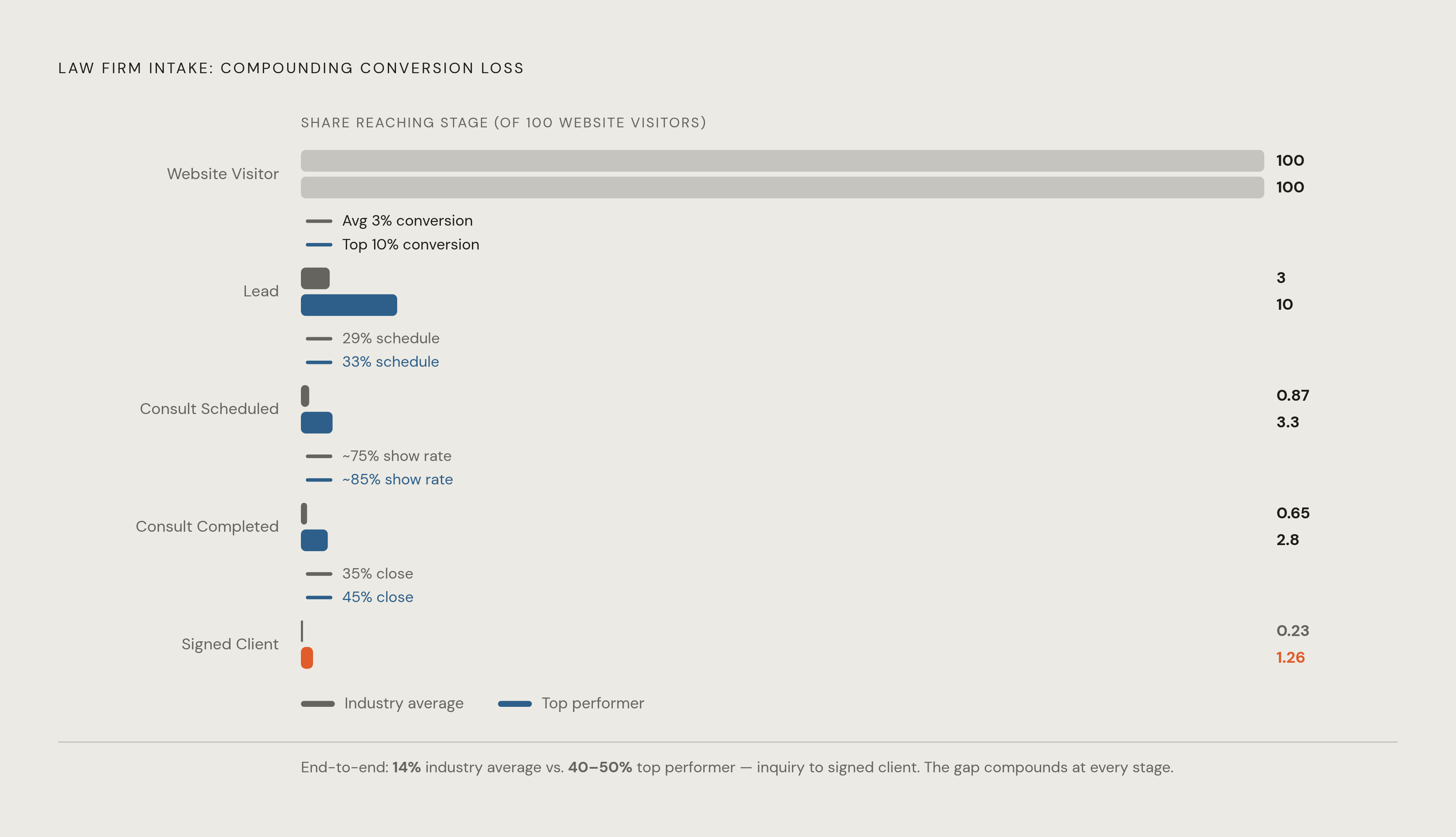
The gap between the best and the rest is the whole story here. Top-performing firms convert 40 to 50% of inquiries into signed clients. The industry average is 14%. That's not a small variance; it's a different business model, and it means most firms are leaving three to four times their potential caseload on the table using the same ad spend.
Platform data tells a slightly different story depending on where it's pulled from. MyCase, which tracks intake data across its user base, puts overall intake conversion at 17.6%, a bit above the 14% inquiry-to-signed figure quoted elsewhere. The gap likely comes down to what counts as an "inquiry" in each dataset, not any real difference in performance. Under conventional, unoptimized processes, most firms are somewhere in the 15 to 25% range.
30 to 50% gets cited often as a general benchmark across practice areas, but it reflects an intake conversion range rather than the end-to-end inquiry rate. Confuse the two and a firm ends up comparing apples to a much smaller basket of oranges.
Funnel Leakage by Stage: Handoff Benchmarks
Start at the top of the funnel. Data from LegalBrandMarketing cited by Hyperleap shows the average law firm website converts 2 to 4% of visitors into consultation requests. Well-optimized funnels reach 8 to 12%, and some highly optimized niche sites can reach well above average. Paid search performs better than organic across the board: Unbounce data cited by Legal Soft puts the median paid legal landing page at 8.3%, while a separate Unbounce figure cited by LEXGRO has the median legal landing page at 6.3%. The gap between a page converting at 6.3% and one clearing double digits typically comes down to a handful of structural and trust-signal differences that are well within a firm's control.
Next handoff: lead to consultation scheduled. Most firms convert somewhere between a quarter and a third of intake calls into booked consultations, though AI-assisted intake can push that figure meaningfully higher by cutting response times and eliminating missed calls. Consultation structure changes the math here too. Free consultations pull lead-to-consult conversion up to 60 to 80%, because there's no barrier to booking one. But that convenience comes at a cost downstream: free consultations also produce lower close rates, while paid consultations flip the ratio, fewer people book, but the ones who do are serious.
That leads into the third handoff: consultation to signed. The industry range is 30 to 40% for free consultations and 40 to 50% for paid ones, with top performers reaching the higher end of that band. The paid consultation model filters out casual inquirers before they ever sit down with an attorney, and that lifts close rates into the 40 to 50% band. No-shows are the silent killer at this stage: a meaningful share of scheduled consultations don't show up at all, and without a reminder system that rate can climb substantially. Automated reminders, text or email, can bring no-show rates down significantly.
Put the stages together and the 14% industry-average end-to-end rate stops looking mysterious. It's compounding loss. The compounding math illustrates it well: a low visitor-to-lead rate, multiplied by a partial lead-to-consult rate, multiplied by a modest consult-to-signed rate, produces a razor-thin end-to-end conversion from raw website traffic. The insight that matters here is that small improvements at each stage compound the same way losses do. Fixing each handoff by even a few points produces an outsized gain in total signed cases, so the next question isn't "what's the industry average" but "which stage is leaking, and which practice area is it happening in.""
Criminal defense and DUI: urgency compresses the funnel and rewards speed above all else
Criminal defense converts better than almost any other practice area, and the reason has nothing to do with sales technique. The overall funnel outperforms most other practice areas, and consultation-to-signed runs 40 to 60% according to available benchmarks. Someone facing a DUI charge or a criminal complaint isn't comparison-shopping three firms over a week. Necessity drives the decision, not persuasion, and that's what collapses the funnel into something far more efficient than personal injury or business law will ever see.
Website design reflects that urgency. High-performing defense firms can hit 15% website conversion rates, a figure attributed to aggressive landing page design that puts click-to-call above every other priority on the page. If someone's looking at a defense firm's site on a phone at 11 p.m. after an arrest, the win condition is getting them dialing in under three seconds, not walking them through a value proposition.
Cost structures split by case severity. DUI cases cluster at $2,000 to $3,000 in client acquisition cost, a reflection of high lead volume and moderate case value. Serious felony cases push acquisition cost toward $7,000, because the keywords are expensive and a smaller share of leads convert into paying clients. DUI keyword costs themselves run $80 to $160 per click, and conversion efficiency at every stage of this funnel translates directly into unit economics. Waste a click at that price point and there's no volume cushion to absorb it the way there might be in a cheaper category.
Personal injury: high lead volume, lower conversion, and the cost of a slow response
Personal injury runs the opposite pattern from criminal defense: huge lead volume, comparatively low conversion. Inquiry-to-consultation is 50 to 70%, consultation-to-signed is lower than in urgency-driven categories, and the overall funnel is 10 to 25%. That low close rate isn't an intake failure, it's a screening function. Case qualification in PI involves filtering out claims that don't meet liability thresholds, don't have provable damages, or fall outside the statute of limitations, and a large share of inbound leads simply don't clear that bar.
The lead-to-signed benchmark is 10 to 15% industry-wide, though top-performing firms reach 25% or higher through optimized intake processes and faster response times. At 10% conversion, a firm running 3,000 leads per month signs 300 cases monthly. Push conversion to 15% with the same lead volume and the same ad spend, and that firm just added a substantial number more cases, the equivalent of a 50% jump in caseload without spending another dollar on marketing. The lever isn't more leads, it's fewer of them slipping through a slow or disorganized intake process.
Paid search economics are tougher in this category than almost anywhere else in legal. Accidents and personal injury law have a 5.45% website conversion rate, among the lowest of any legal category tracked. That's a function of how crowded and generic most PI landing pages have become: broad claims about "no fee unless we win," stock photography, and little that differentiates one firm's page from the next.
Family law: the best unit economics in legal marketing, offset by an emotional decision cycle
Family law funnels look healthy on paper. Inquiry-to-consultation runs 55 to 75%, consultation-to-signed is 25 to 40%, and the overall funnel is 14 to 30%. The intake-to-client conversion benchmark of 25 to 40% is among the strongest of any practice area covered here.
Paid search performance backs that up: the average website conversion rate is 6.3%, and that figure measures visitor-to-lead, not lead-to-client. It's visitor-to-lead, not lead-to-client, and conflating the two overstates how easy family law intake actually is. A high visitor-conversion rate doesn't mean the retainer gets signed easily; it means a lot of people reach out, which isn't the same thing.
Where family law genuinely stands out is unit economics. It carries the lowest cost-per-click and highest conversion rate among practice areas covered here, which produces strong returns for firms built around volume. Bankruptcy law edges it out on the combined metric of lowest cost-per-lead and highest conversion rate, giving bankruptcy the best overall paid search economics in legal. But family law's advantage is a real one, and it's offset by something the numbers don't capture directly: divorce and custody decisions run on an emotional timeline, not a rational one, and firms that treat every inquiry as ready to sign immediately misjudge how long some of these decisions actually take to make.
Estate planning: longer decision cycles, low CPL, and the case for paid consultations
Estate planning funnels move slower than most, and that's by design, not dysfunction. Inquiry-to-consultation runs 40 to 60%, and consultation-to-signed splits by consultation type: 30 to 40% for free consultations, 40 to 50% for paid ones. Overall funnel performance is 14 to 30%. No source confirms a single discrete estate-planning intake-to-client figure separate from these stage benchmarks, so the honest read is to work from the funnel data rather than force a single headline number that doesn't exist in the record.
Lead costs run $30 to $120 per lead, among the lowest cost-per-lead figures in all of legal marketing. That cheapness changes the math on what matters. When leads cost this little, the return on ad spend depends far more on how well a firm converts the leads it already has than on generating more of them.
Deliberation doesn't mean the decision cycle is unlimited. Data from Pareto Legal, cited by Hyperleap, found that 72% of consumers move on within 24 hours even in categories like estate planning and business law where the underlying decision takes longer to make. Estate planning clients cannot be followed up with at leisure; the response window still needs to be tight even though the ultimate decision isn't rushed. The recommended response window for estate planning, along with family and business law, is under one hour. Given the low cost-per-lead in this category, a firm that lets a cheap lead go cold for a day is throwing away one of the best-priced opportunities in the entire industry. That gap between low CPL and slow follow-up is also the practical argument for paid consultations here: charging even a modest fee filters out the 24-hour window-shoppers before they ever occupy a slot on the calendar.
Bankruptcy: the outlier with the strongest paid search economics in legal
Bankruptcy breaks the pattern that governs the rest of legal marketing, where high conversion usually means high cost or low volume. LocaliQ's data puts bankruptcy and tax law at the top of paid-search conversion rates industry-wide, both clearing over 13%. The precise bankruptcy figures from LocaliQ: an average cost-per-lead of $82.27 against a 13.56% conversion rate. Below-average cost paired with above-average conversion is a combination no other legal category in the LocaliQ dataset matches, and it's why bankruptcy posts the strongest paid search economics covered here.
The contrast with personal injury is instructive. PI carries the highest cost-per-lead of any category, north of $159, but big case values absorb that expense. Bankruptcy doesn't have that luxury: case values are modest and fairly uniform, so the entire economic case for bankruptcy marketing rests on volume and efficiency rather than any single case being worth chasing at a premium.
That has a direct operational consequence. The bankruptcy model rewards steady, consistent ad spend over time far more than burst campaigns timed around a seasonal spike. Efficient unit economics in this category only materialize at scale, so firms that turn spend on and off are working against the exact mechanism that makes bankruptcy marketing profitable.
Business and corporate law: the longest sales cycle and a referral-dominated funnel
Business and corporate law close out the comparison with the slowest, least paid-search-driven funnel of any category here. Inquiry-to-consultation runs 35 to 55%, consultation-to-signed is 30 to 45%, and the overall funnel is 11 to 25%. The intake conversion benchmark for transactional and business practices is 15 to 25%, a range that reflects deals and engagements complicated enough that no client signs after a single call.
Paid search benchmarks matter less here than in any other category discussed. Business and corporate clients typically arrive through referrals, existing relationships, and word of mouth built over years of prior work, not through a search ad clicked on a Tuesday afternoon. A firm chasing business-law clients with the same landing-page playbook that works for DUI or personal injury is optimizing for a channel that was never going to carry the weight of that practice area's client acquisition to begin with.
Sources
- 130+ Legal Marketing Statistics for 2025 | Law Firm Marketing Report
- When Minutes Cost Six Figures: The Hidden Revenue Drain in Law Firm Intake - Above The Bar
- Key Legal Intake Metrics for Law Firms (2026)
- Law Firm Lead Conversion: 14% Average, 40% Possible | LEXGRO
- The Law Firm Conversion Rate Benchmark: Why ‘Average’ is a Death Sentence in 2026
- calljolt.com
- hyperleap.ai
- foundrycro.com