AI Intake Tools for Law Firms in 2024
Slow intake costs law firms millions in lost clients every year.

Law firms are losing clients before those clients ever sign an engagement letter, and the mechanism is simple: nobody answers. A secret shopper study from Clio found that only 33% of firms responded to email inquiries from prospective clients, down from 40% in 2019. Phone response fared a little better but still landed at just 40%, down from 56% five years earlier. Shoppers who called firms directly reached a live person only 52% of the time, and nearly half the firms tested were flatly unreachable even after being handed a callback opportunity. That's the median law firm, not some struggling minority of the industry, at a moment when client expectations for speed have only gone up. That's the median law firm, at a moment when client expectations for speed have only gone up.
What slow intake costs a firm in signed clients and revenue
The web-lead numbers are worse than the phone numbers. Among a large sample of firms, 26% never responded to a web lead at all, and only 25% responded within five minutes, a window that affects intake outcomes more than almost anything else in this piece.
Conversion rates track that neglect closely, and the range is the story here, not the average. According to Law Leaders, the average conversion rate from a new call to a retained case is around 7%, but firms with poorly optimized intake convert as low as 3%, while firms running sharp intake systems hit 30%. Industry-wide, MyCase puts the figure at around 14% of inquiries becoming signed clients. MyCase reports an average conversion rate of 17.6%, a bit ahead of that industry figure. Either way, the typical firm is losing five out of every six prospects who reach out, while top performers convert a substantially higher share of inquiries. That gap between median and top is a process gap, and process is fixable in a way that talent never is. It's a process gap, and process is fixable in a way that talent never is.
Why speed-to-lead is the single metric that predicts intake conversion
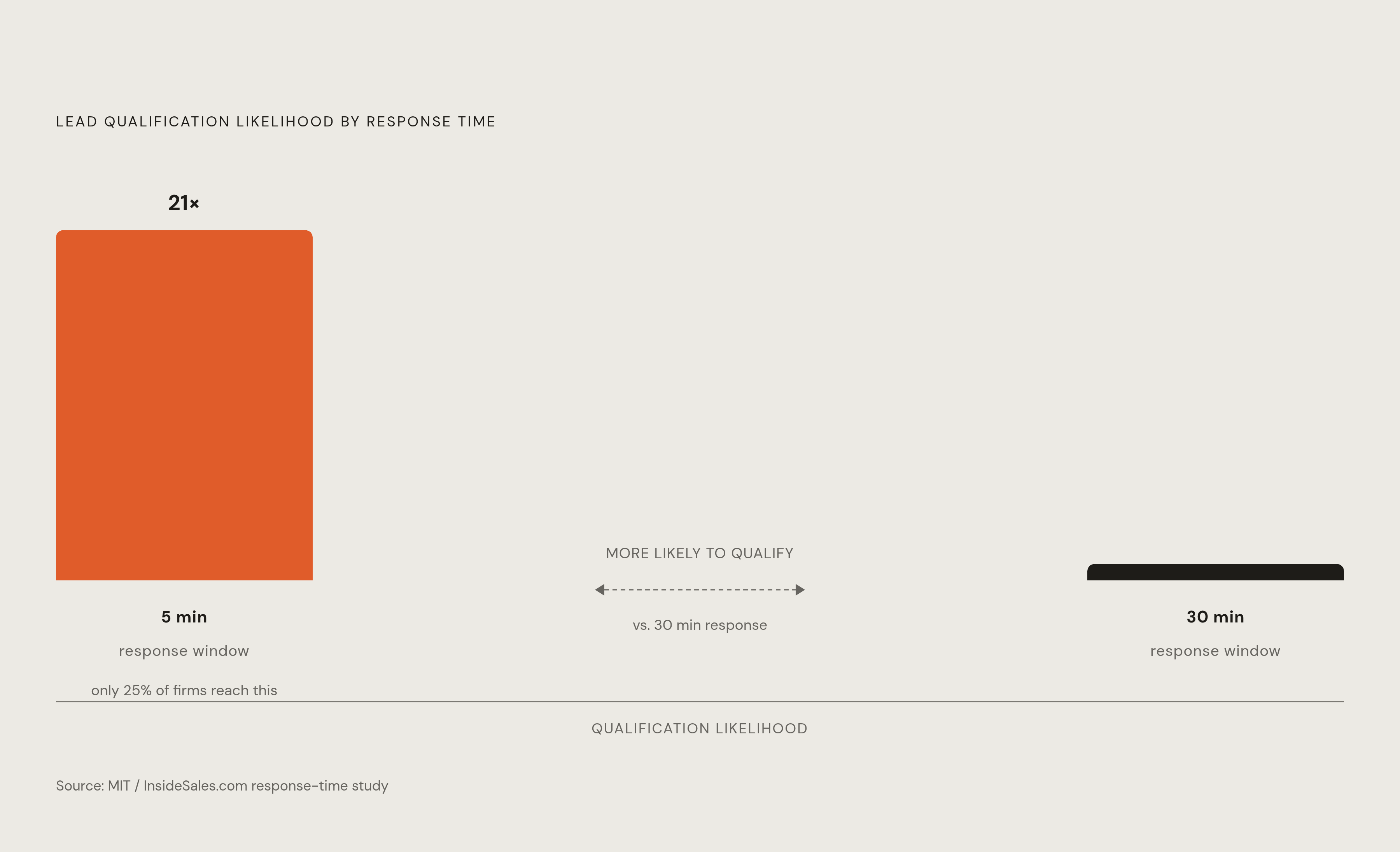
Lead-response research has found that leads contacted within five minutes are roughly 21 times more likely to qualify than leads contacted after 30 minutes. That figure comes from sales research broadly, not law specifically, but the mechanism transfers cleanly: a prospective client who just got hurt, just got served papers, or just got arrested isn't going to sit around waiting for a callback.
Clients say as much directly. Research consistently points to response time as a key factor in choosing a lawyer, and firms that respond within five minutes see conversion rates roughly 400% higher than slower-responding firms, according to Hennessey Digital. Only 25% of firms actually hit that five-minute window. Three out of four firms are competing with one hand behind their back before the call even starts.
None of this is complicated behavior to explain. Legal clients shop multiple firms at once, the way anyone comparison-shops for a service they don't buy often and don't understand well. The first firm to respond with something substantive, not an autoreply, tends to anchor the relationship, and every firm that responds after that first credible contact is already playing defense.
What AI intake tools do: four core functions explained
"AI intake tool" covers a lot of ground, but the category breaks down into four distinct jobs, and conflating them is where a lot of buying decisions go wrong.
Conversational intake, chatbots and text-based triage, handles routine questions, collects the first layer of case details, and qualifies leads around the clock instead of during business hours only. This is one of the fastest-moving segments of legal AI, precisely because it targets the exact failure point the Clio data exposes: nobody picking up the phone.
Dynamic intake forms use conditional logic: the questions change based on how the prospective client answers earlier ones. A car accident lead gets asked about the other driver's insurance; a divorce lead gets asked about children and shared assets. The structured answers flow straight into a case management system instead of sitting in an inbox waiting for someone to type them in by hand.
Automated follow-up sequences trigger emails, texts, or calls the moment a lead goes quiet or a form gets submitted, removing the human dependency from exactly the hour that matters most, when a staff member might be in court, at lunch, or just behind on a Monday.
CRM and practice management integration ties the whole thing together. Once a lead lands, it flows into Clio Manage, Filevine, MyCase, or whatever system the firm already runs, without anyone re-typing a name or a phone number, and converting an intake record into an actual matter becomes a short review process instead of a blank file.
The efficiency case here isn't hypothetical, though the numbers deserve a little skepticism about how they're measured. Firms using these systems report substantial cuts in time spent on manual intake. Research has found that AI-assisted intake reduced average intake time by 35% while increasing the amount of usable case information collected, and this matters because faster intake that captures less information isn't progress: it's just a faster version of the same failure. According to the Clio Legal Trends Report, firms using intake technology see 51% more leads and 52% higher revenue on average. That last statistic is the frame for everything below it: the tools that follow are the mechanisms behind those numbers.
The three market segments AI intake tools fall into
The market splits into three lanes. None of them is objectively better than the others, and picking one has less to do with which is more advanced than with what a firm already runs and where its bottleneck actually sits.
Practice-management bundles, like Clio Grow and MyCase, build intake as one module inside a system that also handles billing and matter management. They win on continuity: one login, one data layer, from the first phone call to the final invoice.
Standalone intake CRMs, like Lawmatics and Lead Docket, exist purely to run intake and marketing attribution, and they go deeper on automation and lead scoring than a bundled tool typically can. High-volume plaintiff firms running paid ad campaigns lean toward these, because they need to know exactly which keyword or landing page produced a signed client, not just that a lead came in.
Conversational triage tools, like Perspective AI, bet everything on the first interaction itself, treating the speed and depth of that initial exchange as the single lever that moves conversion the most.
Adoption varies sharply by practice area, and that unevenness shapes which of the three lanes actually fits a given firm. Immigration firms report the highest generative AI use, at 47%. Personal injury sits at 37%, and criminal law trails at 28%. Firms in the higher-adoption practice areas are, unsurprisingly, further along in figuring out which intake tooling fits their caseload, and the next four sections walk through that.
Practice-management bundles with intake built in: Clio Grow and MyCase
Clio Grow, following a 2024 overhaul, now includes automated intake questionnaires, document collection workflows, e-signature for engagement letters, and lead scoring. Its real advantage is the native tie to Clio Manage: converting an intake record into a matter takes a few clicks, hitting "Convert to Clio Manage," reviewing what's there, adding anything missing, then confirming, with nothing re-entered by hand. That makes it a strong fit for firms already inside the Clio ecosystem running a modest lead volume, though it isn't built to serve as the center of a marketing attribution stack the way a dedicated CRM is, and firms that need that should look elsewhere.
MyCase takes a similar bundled approach: dynamic intake forms feed straight into case management, alongside performance tracking that measures how intake actually converts over time. Its average conversion rate of 17.6% sits above the roughly 14% industry figure cited earlier, and MyCase points to that gap as evidence that tightly integrated intake beats intake bolted on as an afterthought. It suits small to mid-size firms that want one platform running from first contact through the final bill, without a separate analytics tool bolted onto the side.
The shared trait across this whole segment is that integration is the actual product. Intake and matter management sit on one data layer, so nothing gets lost in an export between two systems that don't talk to each other, a smaller-sounding benefit on paper than it turns out to be in daily use.
Standalone intake CRMs built for high-volume and plaintiff firms: Lawmatics and Lead Docket / LeadsAI
Lawmatics has built a reputation as one of the most capable automation platforms in legal intake, and plaintiff firms in particular gravitate toward it. It offers intake forms tied to automated follow-up sequences, lead scoring, and workflow triggers, along with a feature called QualifyAI, which scores incoming leads against criteria the firm sets and routes them accordingly. Where it separates from the bundled tools is marketing attribution: UTM parameter capture is built in natively, and it connects with CallRail and GA4, so a firm running paid search or local service ads can trace a signed client all the way back to the ad spend that produced them.
Lead Docket, Filevine's intake tool, added an AI layer called LeadsAI as a paid add-on in October 2023. LeadsAI writes a summary of everything in an intake form, lead details, message history, notes, using prompts tailored to the practice area: immigration, workers' compensation, personal injury. For motor vehicle accident cases specifically, it runs a predictive analysis to help decide whether a lead should be signed, referred out, or turned down. LeadsAI launched in October 2023 as a paid add-on for Lead Docket customers, landing on top of an existing Filevine install base.
Both tools treat intake as the start of a revenue funnel. Lead scoring and qualification are the point of the product. They're the point of the product.
Conversational and AI-driven intake tools that prioritize the first interaction: Intaker, Smith.ai, and Perspective AI
Intaker runs fully automated chat and SMS conversations, no human on the other end, with lead scoring built directly into the flow. It sorts incoming leads with a traffic-light system so staff know which inquiries to chase first instead of working a queue in the order it arrived. It connects with Clio, Filevine, MyCase, Lawmatics, PracticePanther, Actionstep, and others, which makes it a reasonable fit for a firm that wants automated first contact without paying for live receptionists, so long as that firm already has a CRM downstream to catch what Intaker produces.
Smith.ai takes a hybrid approach: AI voice agents paired with live, North America-based receptionists, available 24/7, with the firm choosing the mix. Calls get screened, basic intake gets done live, and everything logs automatically into Clio, Lead Docket, or Filevine. This suits solo and small firms that can't staff after-hours coverage but also can't afford to lose the after-hours lead, on the theory that some prospective clients want an actual person and a chatbot won't satisfy that. The line between Intaker and Smith.ai is a simple one: Smith.ai puts a human in the loop, and firms that want zero staff involvement in first contact should look at Intaker instead.
Perspective AI sits in this same conversational triage category, betting on the speed and depth of that first interaction as the primary lever for improving conversion.
All three share the same goal: answering the prospective client before any human at the firm even sees the message. The entire value of this segment comes down to closing the gap between someone typing a question and someone, or something, answering it.
In-house legal teams have different intake needs: where Streamline AI and enterprise tools fit
In-house legal departments face a different flavor of the same problem. Requests arrive through email, Slack, or Microsoft Teams from other departments inside the company, not from prospective clients shopping around, so the challenge is volume and triage rather than conversion and revenue.
Streamline AI is built specifically for that environment. It captures, categorizes, and routes internal legal requests, using AI triage to read the content of a request, flag urgency, and assign it to whoever on the legal team has the right expertise and the bandwidth to take it on. Its integrations with Slack and Microsoft Teams matter because they keep the request inside tools lawyers already use, rather than forcing a new interface on them, and that detail tends to decide whether a tool gets adopted or quietly ignored. Teams using the platform report a 60 to 80% cut in time spent on manual intake, the same range cited earlier for AI-assisted intake generally. Beyond triage, it tracks matters end to end, with automated status updates, deadline monitoring, and live dashboards. It's built for mid-market and enterprise legal departments with heavy internal request volume, not for firms trying to sign new clients, and treating it as a substitute for a client-facing tool would be a mistake.
Other tools sit adjacent to this space without being direct intake competitors. Eudia focuses on augmented intelligence for enterprise and government in-house teams, ContractPodAi handles contract lifecycle management, and Tonkean runs broader enterprise workflow orchestration. All three touch intake in the loose sense of managing incoming work, but they're built around matter management or contracts, not around the front door itself. For a law firm chasing new clients, the segments described above, not these enterprise tools, are where the real decision gets made.
What the real-world adoption data says about how far AI intake has spread
Set against the size of the problem, adoption of AI intake tools is still thin. The response-rate failures from the start of this piece, the 33% email response rate, the 40% phone answer rate, describe an industry where most firms haven't closed the gap between the technology on the market and the technology actually running in their intake process. Practice-area adoption figures reinforce that unevenness: immigration firms lead generative AI use at 47%, personal injury is 37%, and criminal law lags at 28%, a pattern that tracks caseload economics and lead volume more than it tracks awareness of what these tools do.
The gap between top-performing firms converting 40 to 50% of inquiries and an industry average near 14% is not a gap better lawyering closes. It's a gap better intake closes, and the tools covered here, bundled, standalone, conversational, or enterprise, are the actual mechanism by which a firm moves from one side of that gap to the other.